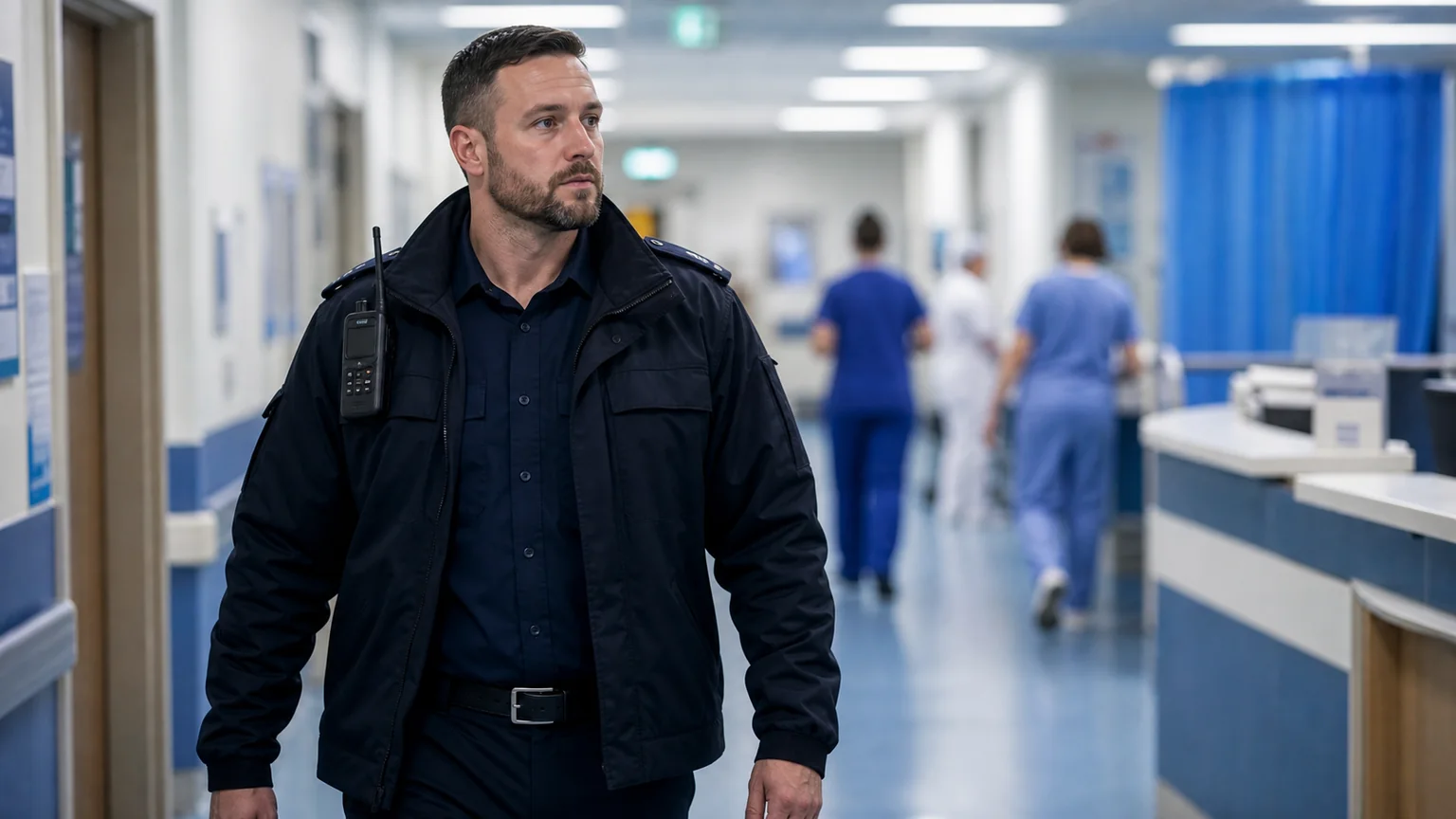
When Martha’s Rule is mentioned, healthcare security officers may reasonably assume it has little to do with them.
The initiative is concerned with recognising possible patient deterioration and ensuring concerns reach an appropriate clinical team. Security officers do not diagnose patients, assess symptoms, or decide treatment plans.
But hospitals do not divide themselves neatly into clinical and non-clinical conversations.
Security officers regularly speak with worried relatives, help people who do not know where to go, support staff during difficult conversations, and meet people who believe nobody is listening. That is where an understanding of Martha’s Rule becomes relevant.
Not because security should become involved in clinical decision-making, but because good signposting, careful listening, and clear role boundaries can help the right concern reach the right people.
What is Martha’s Rule?
Martha’s Rule is an NHS patient-safety initiative developed following the death of 13-year-old Martha Mills in 2021. Her family’s concerns about her deteriorating condition were not responded to, and a coroner later concluded that she would probably have survived if she had been transferred to intensive care sooner.
At the centre of the initiative is a clear escalation route for patients, families, carers, and staff who are worried that a patient’s condition is getting worse and feel their concerns are not being addressed.
NHS England describes three core components:
- Patients are asked at least daily how they are feeling and whether they are getting better or worse.
- Staff can request a review from a different team when they are concerned about deterioration and do not believe the concern is being answered.
- Patients, families, and carers can use an advertised route to request a rapid review.
Martha’s Rule is not a general complaints process and it is not the same as requesting a second opinion about an established diagnosis or treatment plan. It is an escalation process focused on concerns about deterioration.
The current position in England
Martha’s Rule began at 143 pilot sites in May 2024 and is now being implemented across all acute trusts in England for adult and children’s inpatient services. Full implementation in acute inpatient settings is expected during 2026/27.
Hospitals remain at different stages. The initiative may currently operate only in particular wards or services, and there is no single national Martha’s Rule telephone number. Patients and relatives need the local route for the hospital concerned.
That local variation matters for security teams. An officer should not guess, rely on information from another trust, or promise that a particular response will follow. They need to know what applies on their own site and who can confirm it.
Why security teams should care
On paper, Martha’s Rule is a clinical escalation pathway. In practice, the person trying to find that pathway may first approach reception, a volunteer, a porter, or a security officer.
Healthcare security officers are highly visible and available around the clock. They are also called when communication has already become strained.
A relative may say:
- “Something is wrong and nobody is listening.”
- “They are getting worse, but I cannot get anyone to review them.”
- “I have asked several times and do not know what else to do.”
- “I need to speak to somebody senior now.”
Those statements do not make the officer responsible for deciding whether clinical deterioration is occurring. They do indicate that the concern needs calm attention and appropriate referral.
The officer’s role is not to judge the clinical merits of the request. It is to avoid becoming another barrier between the person and the correct clinical route.
Listening can change the direction of a conversation
Frustration in hospitals rarely appears from nowhere.
A family may have been waiting for an update. They may not understand what is happening. They may believe a change in their relative has been missed. Fear and uncertainty can then present as anger.
Listening does not mean agreeing with every claim or making promises about care. It means allowing the person to explain the immediate concern, acknowledging what they have said, and making the next step clear.
Useful responses might include:
- “I can hear that you are worried about a change in their condition.”
- “I cannot assess that clinically, but I can help you contact the appropriate ward team.”
- “This hospital has a process for escalating concerns about deterioration. Let me help you find the correct local information.”
- “I am going to make sure a member of the clinical team knows what you have told me.”
The exact wording matters less than the principle: acknowledge the concern, stay within role, and connect the person with someone able to act.
This reflects a wider point explored in Why De-escalation Phrases Help Healthcare Security Officers: communication works best when it gives the person a credible next step rather than simply asking them to calm down.
Martha’s Rule may support de-escalation, but it is not a tactic
Knowing that an escalation route exists can reduce helplessness and prevent avoidable conflict. However, Martha’s Rule should not be presented as a convenient way to move a difficult person elsewhere.
The concern may be serious. The individual may have already tried ordinary channels. A dismissive or formulaic response can reinforce the belief that nobody is listening.
Security should therefore avoid phrases such as:
- “That is nothing to do with us.”
- “You need to calm down before anyone will speak to you.”
- “Just call Martha’s Rule.”
- “I am sure the doctors know what they are doing.”
These responses either close the conversation, minimise the concern, or imply certainty the officer cannot have.
A better approach is to treat the concern as information that needs to reach the correct clinical pathway while continuing to manage any immediate safety risks proportionately.
Know the local route
NHS England does not publish one telephone number for Martha’s Rule. Each participating hospital advertises its own access arrangements, and implementation can vary by setting.
Security supervisors and managers should make sure officers know:
- Whether Martha’s Rule is active on the site and in which services.
- Where the local contact information is displayed or recorded.
- Who to contact when a patient or relative asks for help accessing it.
- How to obtain interpretation or accessible communication support.
- What to do if the local route cannot be reached.
- How to record and hand over any security involvement.
This does not require officers to become experts in the clinical review process. A short briefing, an accurate control-room reference, and a clear escalation contact may be enough to prevent confusion at a difficult moment.
NHS England’s current Martha’s Rule guidance should be read alongside the trust’s own policy and implementation arrangements.
Keep the boundary clear
Understanding Martha’s Rule does not expand a security officer’s clinical authority.
Officers should not:
- Decide whether a patient is deteriorating.
- Interpret symptoms or observations.
- Recommend treatment or provide clinical reassurance.
- Discourage someone from using the local route because the concern appears minor.
- Guarantee that activation will lead to a particular clinical outcome.
They can:
- Listen and identify that a concern about deterioration is being raised.
- Notify the appropriate clinical staff promptly.
- Signpost the person to the hospital’s published Martha’s Rule process.
- Help maintain a calm and safe environment while the concern is addressed.
- Record relevant factual information about their own involvement.
That boundary protects everyone. It keeps clinical decisions with clinicians while recognising that non-clinical staff can still help people access the correct process.
Security often sees the human side first
Security officers move through areas that clinical teams may only see briefly. They speak with people in entrances, corridors, waiting areas, car parks, and outside wards. They may notice a relative becoming increasingly distressed before anyone asks for assistance.
Observation is therefore relevant even when the officer has no clinical role.
The useful observation is not “this patient is deteriorating.” It may be “this relative has asked three times for help, says the patient’s condition has changed, and is becoming increasingly distressed.”
That is factual, within role, and useful to the staff receiving the referral.
It also demonstrates why the everyday standards discussed in The Small Things Become Big Things matter. Concerns become harder to manage when repeated requests, unclear ownership, or communication gaps are allowed to accumulate.
A simple security response
Local policy must always take priority, but a useful general sequence is:
- Listen: establish what the person is worried about without attempting a clinical assessment.
- Acknowledge: show that the concern has been heard and explain the limits of the security role.
- Refer: contact the appropriate ward or clinical team and state clearly that a concern about deterioration is being raised.
- Signpost: help the person find the hospital’s local Martha’s Rule information where applicable.
- Manage safety: continue to assess the environment, behaviour, vulnerability, and any immediate risk.
- Record and hand over: document relevant security actions in line with local procedure, particularly if conflict or a security response occurred.
This is not a substitute for trust policy. It is a way of keeping the officer’s contribution clear and proportionate.
Final thoughts
Martha’s Rule is a patient-safety initiative, not a security procedure. Yet the values behind it are directly relevant to healthcare security: listen to concerns, avoid unnecessary barriers, communicate clearly, and make sure information reaches somebody able to act.
Officers do not need to make clinical decisions to support that principle.
They need enough local knowledge to recognise the nature of the concern, stay within professional boundaries, and help connect patients and families with the right clinical route.
Sometimes the most useful thing a healthcare security officer can do is not solve the problem. It is make sure the concern reaches the person who can.
For a broader look at communication, observation, and professional judgement across the role, read Healthcare Security Officer Duties: What the Role Actually Involves.