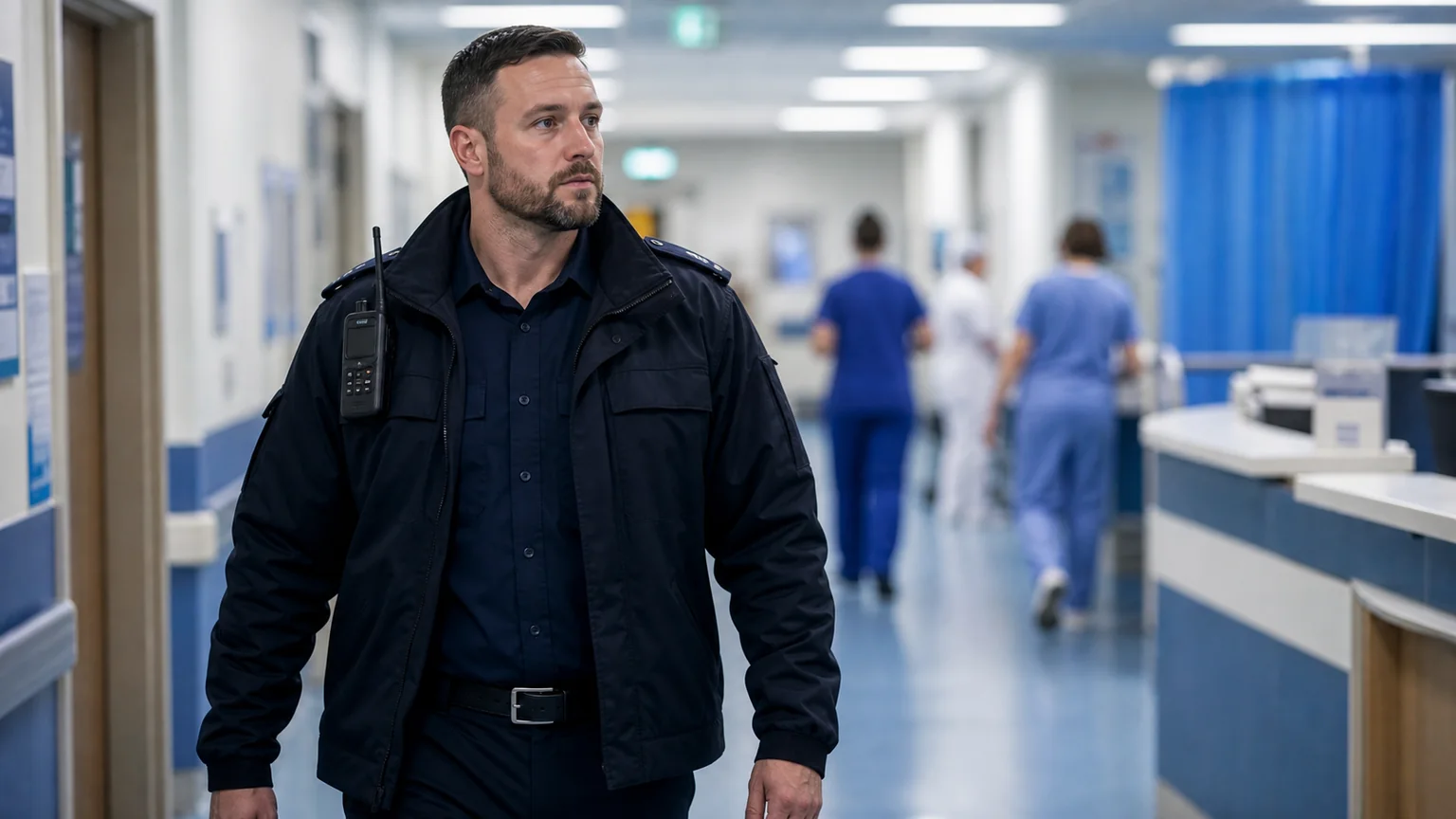
Walk through any hospital on a busy weekday and you will see hundreds of things competing for attention.
Patients arriving for appointments. Ambulances coming and going. Visitors asking for directions. Staff moving between wards. Phones ringing. Deliveries arriving.
In an environment that never really stops, it is easy for small problems to be dismissed.
“It is only a broken door.”
“They have only wandered into the wrong area.”
“It is just someone being a bit abusive.”
“It will be sorted later.”
Individually, none of these issues may seem particularly significant.
But one lesson becomes clearer the longer you work in healthcare security:
The small things matter.
They are often the difference between a hospital that manages risk consistently and one that is always reacting to problems that were visible much earlier.
Looking after the little things
One of the simplest pieces of operational advice is this:
Look after the little things, and the big things tend to look after themselves.
It sounds almost too simple, but the principle appears repeatedly in security work.
Major incidents do sometimes arrive without warning. Many everyday security failures do not. They develop through small defects, repeated exceptions, missed information, and behaviour that gradually becomes accepted.
Security is not only about responding when something goes wrong. It is about noticing the conditions that quietly increase risk and making sure somebody acts before they become tomorrow’s incident.
The useful part of the broken-windows idea
Broken Windows Theory is a well-known and debated idea from criminology. It is often summarised as the suggestion that visible signs of disorder or neglect can signal that standards are not being maintained.
It should not be treated as proof that one broken item will cause serious crime, or used to justify disproportionate enforcement.
There is, however, a useful operational lesson underneath it:
People notice what an organisation appears willing to tolerate.
If equipment stays broken, rules exist but are rarely followed, or unacceptable behaviour receives no meaningful response, people begin to draw conclusions about the standard expected in that environment.
That message may never be spoken aloud. It is still noticed.
Hospitals have their own broken windows
The healthcare version is rarely a literal broken window covered in graffiti.
It looks more like:
- A secure door that is regularly propped open.
- An access-control reader that has been faulty for weeks.
- Visitors entering staff-only areas without being challenged.
- A CCTV camera awaiting repair with no clear timescale.
- Repeated tailgating through a restricted entrance.
- Low-level abuse being dismissed as part of the job.
- An incident log that records a problem but never shows who owns the follow-up.
None of these is automatically a crisis.
The danger begins when the issue stops looking unusual.
The first time somebody props open a secure door, staff may notice. If it happens every day and nothing changes, the exception slowly becomes the normal way of working.
That is when the organisation loses an important layer of protection: the expectation that something out of place will be noticed and addressed.
The standard you walk past
There is a familiar leadership phrase:
The standard you walk past is the standard you accept.
It is powerful because standards are not maintained only through policies, audits, or management instructions. They are reinforced through everyday decisions.
Every time an officer ignores something below the expected standard, that standard can fall slightly.
Not intentionally. Not dramatically. Just enough that the same issue feels less unusual next time.
Professional challenge does not mean turning every minor defect into a confrontation. It means responding proportionately: correct it if safe, report it through the right route, explain the risk where needed, and make sure the concern does not disappear into a handover gap.
That also requires a culture in which officers can raise concerns without first having to prove the full case. The Courage to Speak Up looks at professional curiosity, reporting routes, and what to do when the first response does not resolve the risk.
Risk rarely arrives all at once
One of the biggest misconceptions about security is that serious incidents always begin suddenly.
Sometimes they do. Often, there are earlier signs.
A visitor becomes slightly more confrontational on each visit. Somebody repeatedly tries doors they have no reason to use. A person spends unusual amounts of time photographing restricted areas. Reception staff experience recurring low-level abuse at the same time of day. A faulty entrance repeatedly allows people to bypass normal access control.
Each event might appear minor when viewed alone.
Together, they may show a developing pattern.
The same principle applies to behaviour: look for meaningful change and context rather than treating one sign as certainty.
Good healthcare security officers do more than respond to individual events. They stay professionally curious about what may connect them.
Patterns matter more than isolated incidents
One low-level incident may tell you very little. Twenty similar incidents can tell you a great deal.
That is why reporting apparently minor concerns matters.
Not because every concern is serious. Because organisations cannot identify patterns they do not record.
Without useful information:
- Managers cannot identify recurring hotspots.
- Security teams cannot see developing trends.
- Equipment failures appear isolated rather than persistent.
- Repeat visitors or behaviours may not be recognised.
- The next officer starts with no knowledge of what happened before.
- Resources are harder to justify because the evidence is incomplete.
A good report is not simply a record of the past. It helps the organisation decide what needs to happen next.
That does not mean writing a full incident report for every minor observation regardless of local procedure. It means using the appropriate reporting, defect, intelligence, or handover route consistently and recording enough factual detail to make the information useful.
Reporting is not the same as resolving
There is an important weakness in many systems: a problem is reported, so everybody assumes it has been dealt with.
Logging a faulty door does not repair it. Recording abusive behaviour does not support the member of staff affected. Mentioning a camera fault at handover does not create ownership.
Good standards need a closed loop:
- Notice the issue.
- Make the immediate situation as safe as reasonably possible.
- Record or report it through the correct route.
- Identify who owns the next action.
- Escalate if the risk remains or the action stalls.
- Confirm the outcome where local systems allow.
Security teams will not own every repair or operational decision. They do need enough visibility to know when an unresolved issue continues to affect risk.
Security is everybody’s business
Healthcare security officers rarely see the entire picture alone.
Reception staff notice unusual visitors. Porters see movement across multiple departments. Domestic teams spend time in areas others rarely enter. Clinical teams recognise changes in patient behaviour. Estates colleagues understand building systems. Volunteers sometimes notice details precisely because they are not focused on clinical tasks.
No single person sees everything.
A safer hospital is built when those observations can reach the right people and be combined with information from elsewhere.
Sometimes the most useful piece of information seems unimportant until it connects with something somebody else reported earlier that day.
That is why professional relationships matter. Staff are more likely to raise concerns when security officers listen, respond calmly, and explain what information would help.
Do not normalise poor practice
Normalisation of deviance describes the way an unsafe departure from expected practice can gradually become accepted when it is repeated without an obvious bad outcome.
In plain language: people keep doing something the wrong way because nothing went wrong last time.
Healthcare security hears versions of this regularly:
“We have always done it this way.”
“It is only temporary.”
“Nothing has ever happened before.”
Those statements can feel reassuring. They do not prove the practice is safe.
The fact that a propped door has not yet led to unauthorised access does not make it a reliable control. The fact that repeated abuse has not yet become violence does not make it acceptable. The fact that a radio blackspot has not yet affected an urgent response does not remove the weakness.
Good healthcare security challenges poor practice before familiarity disguises the risk.
Early intervention is better than crisis management
Fixing a faulty door is easier than investigating an unauthorised entry.
Supporting a staff member experiencing repeated abuse is better than waiting for an assault.
Addressing recurring access concerns is less disruptive than managing a serious incident later.
Early intervention still needs judgement. Officers have to consider urgency, vulnerability, immediate hazards, available support, and what control measures are realistic while circumstances are changing.
The aim is not to treat everything as an emergency. It is to prevent familiarity, workload, or inconvenience from making genuine concerns invisible.
What consistent standards look like on shift
Strong standards are usually visible through ordinary habits:
- Officers arrive properly briefed and pass on unresolved risks.
- Access-control failures have temporary controls and clear escalation.
- Low-level aggression is taken seriously without being exaggerated.
- Professional challenges are calm, respectful, and proportionate.
- Reports distinguish observable facts from assumptions.
- Repeat locations, people, defects, and behaviours are identified.
- Radio messages give colleagues useful information rather than noise.
- Staff know that raising a concern will lead to a sensible response.
- Supervisors review whether agreed actions actually happened.
These habits are not glamorous. That is precisely why they matter.
They are the daily work that prevents poor practice from becoming normal practice.
Routine patrols are one place where those habits become visible: an officer notices a change, checks it within their remit, and makes sure the concern reaches the right person. The security patrols topic looks more closely at that everyday work.
Final thoughts
Healthcare security is not simply about responding to emergencies.
It is about protecting standards, noticing change, and refusing to let avoidable risks quietly become accepted.
Small issues have a habit of growing when they are repeatedly ignored. Not because every minor fault becomes a major incident, but because unresolved problems change what people think is normal.
The best healthcare security officers understand this instinctively.
They challenge poor practice professionally. They report concerns others may dismiss. They recognise patterns. They follow up. And they know that today’s minor issue can become tomorrow’s major problem if everybody assumes somebody else will deal with it.
For a broader look at how these responsibilities fit into day-to-day practice, read Healthcare Security Officer Duties: What the Role Actually Involves.